Flighty Hearts & Broken Parts Book Review: M/M romance and cozy monsters

Flighty Hearts & Broken Parts Book Review: M/M romance and cozy monsters

This is the first book I’ve ever read by Rhea Fox, but I feel like it’s a good introduction to the author. Flighty Hearts & Broken Parts is a quick read that’s easy to jump into and sweet as can be. All the best moments of falling in love and building a life together are offered in convenient novel form and shared between a breezy Slyph and a solid orc.

How it all starts

Beryl is an airy flighty Sylph, which is a pun because Sylphs are air spirits. (I’d heard of Syphs before but definitely didn’t know what they were, so I learned something.) Beryl works in a cafe and isn’t expecting a serious relationship but there’s something about the quiet orc that captivates him.

Kjartan is an orc who’s seen his share of battle in the past and is now trying to enjoy a normal life. He’s got some scars and baggage, but a new relationship with the right Slyph is apparently just what he needs to open up his heart.

While it starts as mutual attraction and an attempted hook up, things get domestic fast.

My Thoughts – It’s All About the Relationship

The novel is sweeter than a chocolate latte with extra caramel drizzle. Low stakes and no angst or greater plot isn’t really my cup of tea, but it’s a nice little change of pace to just read a book all about a romance blossoming. Beryl and Kjartan grow closer and build a relationship together and it’s fun to see them fall for each other.

Adorable as the couple here is, they have no trouble heating things up. There’s a lot of steam and not from cappuccinos. Not really what I expected from such a cute read but the scenes were welcome and very well done.

I also liked the Slyph and orc pairing, two rarer paranormal species that you don’t see every day.

Here’s a passage from the novel:

Reading Order and Hetero Warning

Reading out of order makes me twitchy and not only is this the second book in this series, it’s part of a whole larger universe that takes place in the Scottish city of Kirkmuir, which is not a real place since it’s heavily populated with supernatural folk.

This a cozy little novel, and there’s no huge plot details to learn before diving in so it’s probably okay to read in any order. But if you like low angst cozy romances and really want to get absorbed in the little world, probably best to read ‘em all. I mean, you don’t have to, but I can’t encourage you to be a rebel and go out of order like I did.

Keep in mind the first book and some of the novels in the series are M/F in case that’s not your thing.

Official Book Description

One is all wind and whimsy. The other all scars and silence. Together, they’re building something that just might last.

BERYL
Relationships? Not my thing. I like flirting, pretty things, and keeping things breezy—just like a good Sylph should. I’ve got a job I love, coworkers I adore, and enough sparkly highlighters to wallpaper a house. So why does Kjartan, the hulking orc carpenter with a quiet voice and a missing finger, make my heart flutter like it’s been caught in a windstorm?

One failed hookup and a surprising proposal later—dating, not that other D-word—and suddenly we’re buying furniture together like a couple of nesting lovebirds. But is good sex and shared home decor taste enough to bridge the gap between his countryside roots and my city life? Or am I doomed to fly solo again?

KJARTAN
After everything I’ve been through, I know better than to believe in second chances. But Beryl—bright, bold, unpredictable Beryl—sees through the walls I’ve spent years building. And somehow, he likes what he finds.

A single night with him turns into something more: weekend visits, cozy nights, and building a life one bookshelf at a time. But can I risk my heart again for someone who’s made of wind, here today, gone tomorrow? Or is this the moment I finally let myself believe in love?

Flighty Hearts & Broken Parts is a cozy MM monster romance featuring a silent orc with a broken heart, a flirty Sylph who talks a mile a minute, chore play, shared home improvement projects, and a low-stakes love story filled with warmth, healing, and a guaranteed HEA.

Book 2 in the Scales & Steam series – can be read as a standalone.
Hunger and Horror Personified: The Wendigo

Hunger and Horror Personified: The Wendigo

They say when the night’s too dark and the forest too quiet… that’s when the wendigo is near.

As far as monsters go, the wendigo is pretty terrifying. It stalks the frozen wilderness, a specter of hunger that can never be satisfied, with an appetite for human flesh.

Legends say that those who are desperate enough to engage in cannibalism when on the brink of starvation can transform into this beast. The wendigo myth emerges from Algonquian tribes across the northeastern woodlands of North America. The legends were cautionary tales in places with harsh winter climates where survival was hard and starvation was always a concern.

Since the Until Dawn movie came out recently, I wanted to look into wendigo lore. This is about all I can handle because horror and I don’t go together too well. The movie is guaranteed to be too scary for me. The video game looked interesting and I even watched some videos about it, but I was not brave enough to actually play… and I’m not much a PC gamer.

(Photo: Legends of Windemere)

Origins & Mythological Roots

The wendigo’s origins can be traced back to the Anishinaabe, Cree, Ojibwe, Innu, and other Algonquian-speaking tribes across Canada and the northern United States.

Early European settlers and fur traders documented these stories in the 19th century, often with a mixture of dismissal and fascination. But those who spent enough winters in the northern forests began to understand why the wendigo held such power in indigenous consciousness. When blizzards howl for weeks and food stores dwindle, the human mind can wander to dark places.

Unlike many monsters that simply prey on humans, the wendigo represents what humans can become when they surrender to their basest instincts.

Appearance and Characteristics

Photo: Rishi

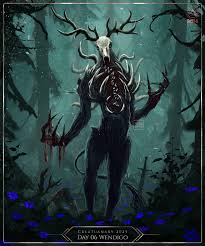
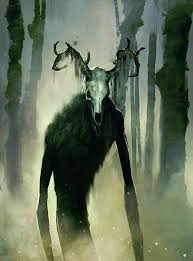
Picture this: a gaunt, towering figure with ash-gray skin stretched tight over a skeletal frame. Eyes sunken deep into hollow sockets, yet burning with an insatiable hunger. Lips torn and bloody from feeding. Claws that can rend flesh from bone. In some descriptions, the wendigo’s heart is made of ice and literally frozen solid. The modern image of the wendigo often includes antlers or a deer skull for a head.

What’s particularly terrifying about the wendigo is that it grows with each victim it consumes, yet it never feels satisfied. Its hunger only increases proportionally to its size. Constantly hungry and never full despite feasting, this is the stuff monsters and metaphors are made of.

Wendigos may be accompanied by bone-chilling cold or a putrid stench like decaying flesh. Nature itself seems to recoil from the creature’s presence, birds fall silent, small animals flee, and even the wind seems to hold its breath.

Transformation and Powers

The transformation from human to wendigo typically follows one of two paths: either consuming human flesh during times of famine triggers a physical metamorphosis, or a wendigo spirit possesses a vulnerable person, usually someone weakened by greed, despair, or isolation.

In traditional lore, the wendigo embodies winter’s cruelty. It can manipulate temperature, bringing killing frosts or blizzards. Wendigos are smart predators, luring victims away from safety by mimicking the voice of a loved one calling for help in the darkness. Some stories grant it supernatural speed, allowing it to stalk prey for days without tiring.

Protections and Weaknesses

Traditional protections against wendigos were primarily preventative. Don’t travel alone during the deadliest part of winter. Don’t speak the creature’s name unnecessarily. Maintain strong community bonds that prevent the isolation where wendigo possession takes root.

Some later stories mention fire or silver as wendigo weaknesses, possibly influenced by European werewolf lore. Indigenous traditions emphasized spiritual remedies administered by healers or medicine people for those showing early signs of wendigo transformation.

Media Appearances

Supernatural featured the creature in its first season, emphasizing its voice mimicry and twisted appearance. The TV show Hannibal made subtle nods to wendigo lore throughout its run, with the titular character’s murderous cannibalism visualized through wendigo imagery. (Sidenote: I really wanted to watch Hannibal because I loved Bryan Fuller shows and tried to watch, but the cannibalism squicked me out too badly. I gave it another shot due to all the queerness but still couldn’t do it. Maybe one day.)

Gaming has perhaps embraced the wendigo most enthusiastically. In addition to 2015’s Until Dawn, Fallout 76 incorporates them into its post-apocalyptic landscape. The creature appears in everything from The Dark Pictures Anthology to various Marvel games.

Historical Sightings & Scientific Explanations

One of the most documented wendigo-related incidents involved Swift Runner, a Cree man who killed and ate his family during the winter of 1879. He claimed to be possessed by a wendigo spirit, and while authorities attributed his actions to starvation-induced madness, his community recognized the pattern of wendigo possession.

Skeptics point to severe nutritional deficiencies, isolation-induced psychosis, and protein poisoning (sometimes called “rabbit starvation”) as potential scientific explanations for historical wendigo cases. When the body consumes its own fat reserves during starvation, the resulting ketosis can cause hallucinations and irrational behavior.

Oral traditions contain numerous accounts of humans transforming into wendigos, as well as stories of brave individuals hunting these creatures. The “First Dog” legend describes how dogs came to be human companions after helping to defeat a wendigo. Not surprising. Dogs are the best.

Quotes and Literary Excerpts

The wendigo’s journey from indigenous oral tradition to pop culture staple began in earnest with Algernon Blackwood’s 1910 short story “The Wendigo.” Blackwood captured the psychological dread perfectly with lines like “An old Wendigo broke through… slender as a sapling, yet gaunt as famine.”

Beyond Blackwood’s famous description, wendigo lore has inspired powerful language across literature. A Cree legend describes the wendigo’s endless hunger: “It grows with each life it eats—but still, it starves.”

Stephen King, in “Pet Sematary,” writes: “The Wendigo, that creature that comes to you in the pitiless winter…that makes you eat your own flesh and grow huge…and still be hungry.”

These quotes capture what makes the wendigo uniquely terrifying: it’s hunger personified and it’s not just a monster that eats you; it’s a monster you become.

Final Thoughts

The wendigo is a chilling reminder that under extreme circumstances the line between humanity and monstrosity can blur. It speaks to our deepest fears about hunger, isolation, and desperation. The most frightening monsters aren’t those that simply hunt us, they’re the ones we might become.

Sources

Britannica: https://www.britannica.com/topic/wendigo

Wide Open Spaces: https://www.wideopenspaces.com/wendigo/

Whispers of the Unknown: https://crypticfolklore.blogspot.com/2024/05/wendigo-mythology-origin.html?

Mythology Worldwide: https://mythologyworldwide.com/beyond-the-cannibalistic-monster-exploring-the-wendigos-deeper-meanings/

EBSCO Research Starter: http://www.ebsco.com/research-starters/religion-and-philosophy/wendigo-folklore?